YouTube Video Size and Resolution Guide
The ideal YouTube video size is 1920x1080 pixels with a 16:9 aspect ratio, and getting those dimensions right before uploading gives your footage the best chance of looking sharp on the platform. Though it's the biggest video platform, YouTube doesn't magically make any clip look good there upon uploading, so creators need to handle video size, format, and export settings themselves.

Whether you're starting a YouTube channel, uploading videos from time to time, or learning the basics of video prep, the real work starts before publishing. It's not just the upload itself, but the preparation phase – filming, resizing, editing, and exporting – that determines how well a video will present itself once it goes live.
This guide breaks down the YouTube video size rules you actually need: recommended resolutions and aspect ratios, file size and duration limits, supported formats, ways to resize footage, and practical tips for editing, titling, thumbnails, and keeping viewers engaged. When your video has the proper width and height, you avoid unnecessary quality loss and give people a better viewing experience from the first play.
YouTube video guidelines
YouTube began in 2005 as a simple platform where anyone could upload short, casual clips – much like a digital home video album. At that time, videos were often low resolution, amateurish, and constrained by slow Internet speeds.
Jump ahead to 2026, and YouTube has evolved into a sophisticated ecosystem hosting billions of videos, ranging from polished music videos and video podcasts to professional tutorials and cinematic productions.
Like any other video platform, YouTube has its own set of rules, or rather, principles about the size and video resolution. While they are not mandatory per se, if you decide to use a custom size, like square videos, they may not look as good, since they will be fitted to the platform anyway.
To avoid this issue, it's better to resize the video beforehand. But first, let's see what kinds of sizes are standard for YouTube videos.
Aspect ratio and resolution
Generally, the most common YouTube video dimensions can be the following:
- 426 x 240
- 640 x 360
- 854 x 480
- 1280 x 720
- 1920 x 1080
- 2560 x 1440
- 3840 x 2160
- 7680 x 4320
If you're unsure which YouTube video size to choose, go for 1920x1080 pixels (Full HD) with a 16:9 aspect ratio. 1280 x 720 is the minimum resolution for HD playback, while 854 x 480 is an acceptable standard-definition resolution for mobile devices with smaller screen sizes.
YouTube also supports a 1:1 aspect ratio for square videos, though they may appear with black bars or use less of the player.
File size and duration
YouTube supports large, high‑quality files, but there are limits. The maximum size of a single video file is 256 GB. In practice, most edited videos under an hour are far smaller, but the exact file size depends on resolution, bitrate, and codec.
There is also a time limit. For verified accounts, the maximum video length is 12 hours. Unverified accounts are limited to 15‑minute uploads, regardless of file size.
File format
YouTube video formats are many! Accepted file types include MOV, MP4, AVI, WMV, and others. But for YouTube uploads, the preferred video format is MP4 with H.264 video and AAC audio, since it offers broad compatibility and a good balance between quality and file size.
YouTube Shorts
YouTube Shorts format is designed for vertical viewing on mobile devices and fills the entire screen. It follows the same general rules but differs in dimensions and duration. For vertical videos, the standard is:
- Aspect ratio: 9:16
- Size: 1080 x 1920 pixels
- Duration: No more than 60 seconds (ideally 15-30 seconds)
How to resize your video for YouTube
If you want to upload a clip that doesn't fit YouTube video resolution, don't worry – it's totally fixable! Aspect ratio and even the specific number of pixels are not set in stone, and you can easily resize the video however you want in just a few clicks. There's plenty of free video editing software to help you with that. And if you don't want to spend your time on downloads, you're in luck. We have an online tool for you. How to do it exactly? Let's find out!
-
Upload a video file
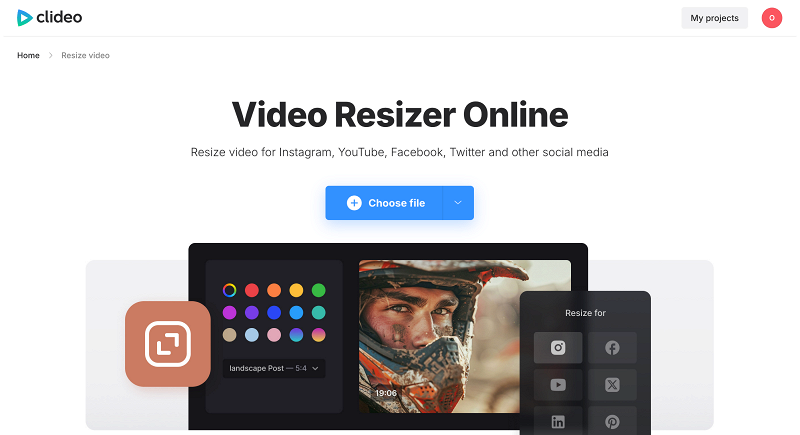
Go to Clideo's Resizer and click "Choose file" to upload the clip you need from your device. You can also access files from your cloud storage by clicking the upload arrow on the right, then selecting the appropriate option.
-
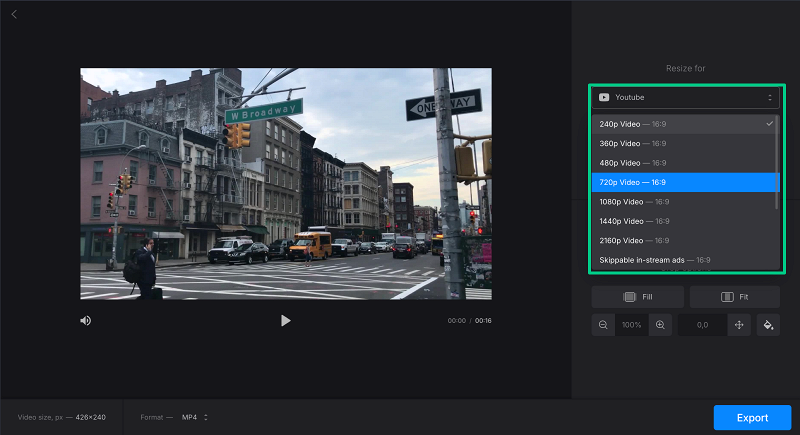
Choose the 16:9 aspect ratio
Select the required aspect ratio from the preset drop‑down list. It also includes other aspect ratio presets for other platforms if you plan to post your clip elsewhere.
However, if for whatever reason you don't want to use the preset's dimensions, you can set your own! It's simple – just select the "Custom" option, untick the chain icon between the text boxes, and put the values you need there.
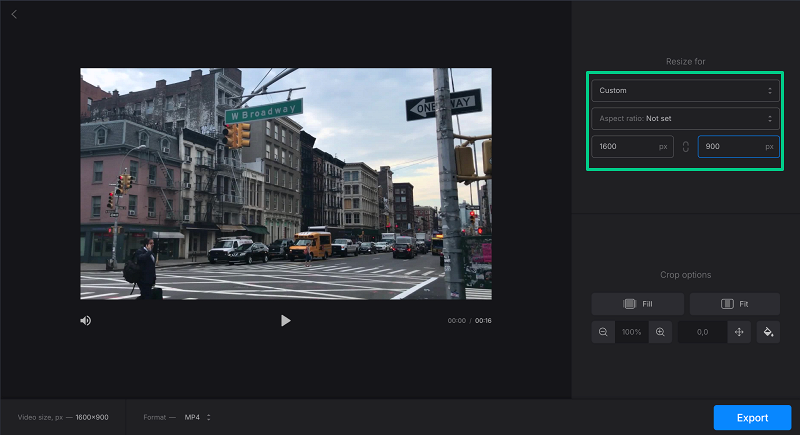
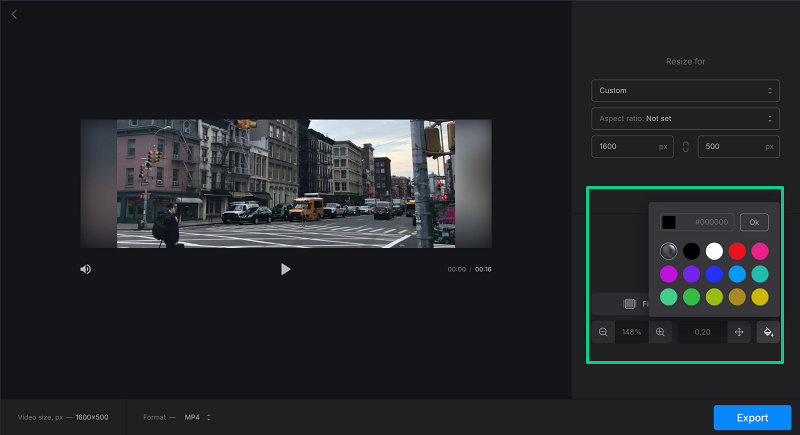
If your chosen size creates black bars on the sides of the video, you can pick their background color. You can also zoom in on the frame and adjust its position to crop something out of frame.
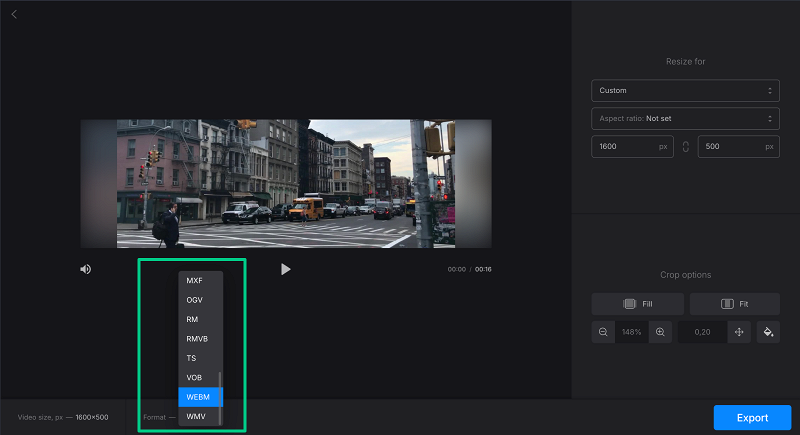
It's possible to change the output format to MOV, but the default MP4 is better for social media and general use.
Once finished, click "Export" and wait for a few moments.
-
Download the result
When exporting is complete, take a quick preview to make sure the playback quality meets your expectations. If so, save the video to your device or upload it to a cloud storage service. Otherwise, click "Edit" to go back and fine-tune the size more.
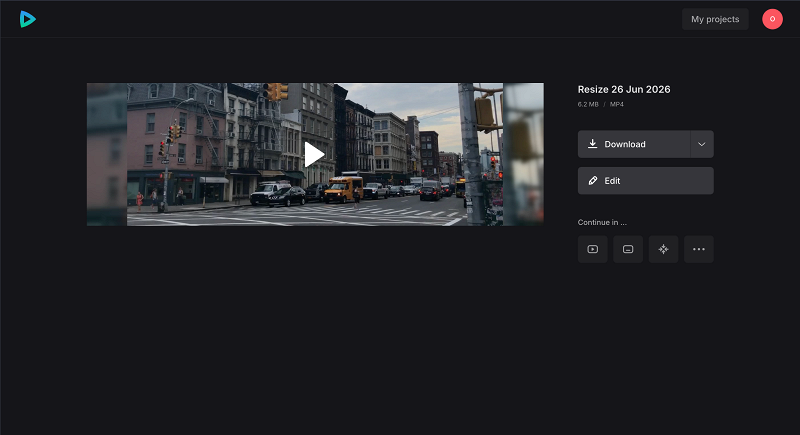
We regularly improve our tools to add new features or enhance your experience. Check our Help Center for the most recent instructions.
Tips and best practices for YouTube videos
If it's your first time using YouTube as a creator, it may be helpful to know a few things in advance. Although it's a video platform just like TikTok, its core principles are very different and not interchangeable if you want to post videos that adhere to its respective standards. But other things work perfectly for both platforms.
When it comes to YouTube specifically, important things to consider are the following:
-
What to film about
Topics and themes are vital parts of the process because if they aren't interesting to you, you'll quickly give up.
To avoid it, try to choose one topic and stick to it. If you're juggling different topics as a starting point, the viewer won't know what to sign up for, and the subscribers you already have may unsubscribe when they see videos outside their areas of interest.
Also, don't try to make a long video right away; unless you're really prepared and have it fully researched, scripted, and ready to be filmed, of course. It's best to start with something simple yet useful to find your niche and improve video quality without worrying about hours of footage.
Sometimes, even experienced creators can struggle to come up with ideas for their YouTube channels, and for beginners, it's even more evident. If you can't think of something on the spot, remember – the best videos are often born from emotion. For example, if you're learning Chinese, you can make videos with topics like "Why are Chinese characters SO difficult?" or "3 mistakes I made when learning Chinese".
-
How to film
That question is quite popular among beginners, as we all want high-definition quality without spending a lot of money. Luckily, you don't need an expensive camera to start – a phone is great equipment! Or you can even use screen recordings, if you want to record something on different devices.
Plus, the most important element is sound, not a picture. People hate bad sound, and even a good picture will not stop them from turning off the video. If you'll be filming with your phone close, it may not be an issue, but otherwise, look for a simple lavalier microphone.
The light source is also more important than the camera. If you don't have a dedicated filming lamp, a simple trick is to place a desk lamp behind your phone to shine on your face. And, of course, don't film against a window during the day, as it will create a dark silhouette.
Another difficulty is actually shooting a video. If you don't have a script and need to improvise around your topic, you may often feel stuck or as if you're wasting time. Don't be too hard on yourself, but in this case, you can try filming in short takes, e.g., 30-60 seconds per take. Don't try to say everything in one go – say a few sentences and stop recording! It's easier to re-shoot just one small section than the entire video.
-
How to edit
Video editing often intimidates beginners, but actually, it can be quite simple and quick.
First things first, cut the silence. Remove pauses when you're silent or thinking, if they don't add anything to your cause. It will speed up the rhythm, leading to a more pleasant viewing experience.
Also, you can add subtitles! A great number of people watch YouTube without sound (on the subway, at work, etc.), so if you don't have subtitles, they won't become your potential subscribers. Plus, it's easy to do – just upload the video, wait 30 minutes, and YouTube will automatically create subtitles; then you can check them and correct any errors.
As for the editing process, you can start with a simple and free tool to learn. For example, with Clideo's Online Editor, you can work on your video on either your PC or your phone, and even switch devices mid-edit! It also offers many features that help you save time when repurposing content into different YouTube-friendly sizes and keep your enthusiasm up by letting you see the results of your work immediately.
-
How to name and format a video
A YouTube thumbnail and title are the first things people see, and together they're the main click-driving elements — if they're boring, people won't open the video. While you can't reach every potential viewer, you can at least increase the likelihood of grabbing the attention of your intended audience.
For example, make your title a promise of benefit. Titles like "How to do your thing in 5 minutes" or "3 ways to do your thingfaster" seem to work perfectly, especially if it's not clickbait.
A strong video thumbnail should be bright and clear. Popular template includes a large face (yours or your persona's) and 3-5 large words on the cover that convey the key info or emotion. The recommended dimensions for YouTube thumbnails are 1280 x 720 pixels with a 16:9 aspect ratio to ensure they remain clear and sharp across all devices. The maximum file size is 2 MB, and accepted formats are JPG, PNG, and GIF. And, of course, use bright colors, but don't forget to increase contrast since YouTube compresses colors.
-
How to manage YouTube and viewers
If you're worried about monetization, in the beginning, it's just making videos for fun. But on this stage, you'll get to know whether you'd like this kind of commitment, and if not, you can just quit anytime.
Then there's a question of comments. As a rule of thumb, try to reply to ALL comments – even the bad ones. If nothing comes to mind, something like "Thanks for your opinion, I'll take it into account!" will do nicely. This increases loyalty and engagement.
Also, consistency is more important than quality, in the beginning. It's better to post one short video every week than one perfect video once a month, unless the latter one is your intention all along. On YouTube, the minimum is one video every two weeks to keep your channel "live."
And don't forget to watch your old videos after some time has passed! You'll easily see the mistakes you've made, and that's normal. Even if it upsets you, look at the bright side – if you think you were worse, then it means you're much better now!
The best all‑round choice is a 16:9 aspect ratio at 1920 x 1080 pixels (Full HD). If you want even sharper quality, 2560 x 1440 pixels is a strong option. YouTube supports everything from standard definition up to 8K, but higher resolutions can take a bit longer to process after upload.
For standard YouTube videos, use a 16:9 landscape aspect ratio. For YouTube Shorts, stick to a 9:16 vertical aspect ratio so your clip fills the screen on mobile. Other formats, like 1:1 square, are supported and can work well for repurposed content, but they may not fill the player the same way as the default layouts.
For most uploads, MP4 is the best choice because it balances quality, compatibility, and file size. YouTube also supports formats like MOV, AVI, and WMV, so you usually will not have issues with common file types. If your video is in a less common format, you can convert it to MP4 before uploading.
The maximum file size is 256 GB, and the maximum length is 12 hours. Larger files will not upload, and videos longer than 15 minutes are only available to verified accounts. Unverified channels are limited to 15 minutes per upload, regardless of file size.
Start with shorter videos to quickly test topics, styles, and thumbnails. Use clear, benefit‑driven titles and simple, high‑contrast thumbnails that are easy to read on small screens. Make sure your channel art and banner are sized correctly so key text and graphics stay visible on phones and tablets. Finally, reply to comments and invite feedback to build a more engaged audience.


